2026-08-29 ·
Cost Comparison Of LED Versus Fluorescent Shop Lights
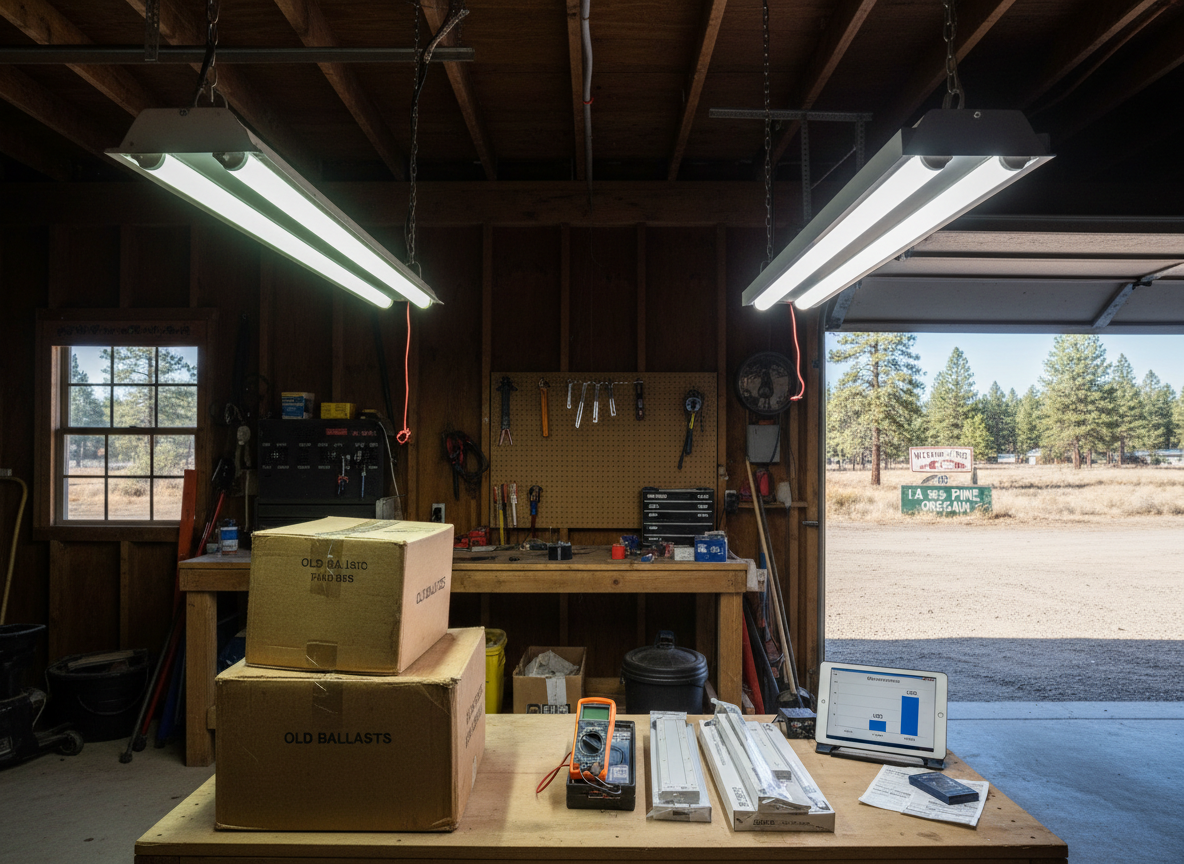
LED shop lights typically cost $35–$120 per 4-ft fixture versus $25–$70 for comparable fluorescent units, use 12–18 watts instead of 32 watts, and last 50,000 hours versus 10,000–15,000 hours, so a two-bay garage in La Pine often sees payback in 1–3 years once winter shop hours climb. Those ranges assume T8-style 4-ft lamps or integrated LED strips common in Deschutes County outbuildings, 4–8 hours of daily use, and Pacific Power rates near $0.12–$0.14 per kWh. Fluorescent still wins only if you already own working ballasts and run the lights under 300 hours a year. Everything below unpacks the numbers for high-desert shops near Downtown La Pine, Sunriver, and Bend, including how cold starts and older wiring change the real bill.
Upfront Fixture And Lamp Costs In Deschutes County Shops
A basic 4-ft fluorescent shop fixture with two T8 lamps and a magnetic or electronic ballast still lists around $25–$70 at local suppliers, plus $6–$12 for a pair of replacement tubes. Equivalent LED integrated fixtures or high-output strips run $35–$120 depending on lumens (usually 4,000–8,000) and whether they are linkable. Retrofit LED tubes that drop into existing fluorescent housings cost $12–$28 each and skip a full fixture swap if the tombstones and wiring are sound. In older cabins and pole barns around Downtown La Pine and along the Little Deschutes River, many fluorescent fixtures date from the 1990s–2000s; corroded sockets and failing ballasts add $15–$40 in parts before you even buy lamps. LED fixtures often include the driver, so you avoid a separate ballast purchase. For a typical two-car garage with four 4-ft units, fluorescent hardware might total $140–$320 while LED hardware lands $180–$480. Those figures exclude labor; hanging new fixtures on existing boxes is usually a half-day job if the circuit is already there. If the shop sits on a 15-amp lighting circuit shared with outlets, you may need extra work before either technology is safe to load. See cost factors for adding circuits to a La Pine garage when the existing run cannot support more lights.
Energy Use And High Desert Winter Runtime
A pair of 32-watt T8 fluorescent lamps draws about 64–70 watts including ballast losses. A comparable LED 4-ft fixture draws 12–18 watts for similar or better lumens. At 6 hours per day, 180 days of shop use (common once high-desert winters drop below freezing and people work inside), that is roughly 76 kWh versus 19–32 kWh per fixture per season. At $0.13 per kWh the fluorescent fixture costs about $10 per winter while the LED costs $2.50–$4. Four fixtures therefore save $24–$30 in electricity each cold season. Warm summers around La Pine State Park cut runtime, but many owners still run lights for evening projects. Fluorescent output also sags in unheated shops; starting a T8 below 50°F often means dim, flickering light until the lamp warms, so people leave them on longer. LEDs reach full brightness in seconds even when the shop is 20°F. Over 10 years at 1,000 hours per year, energy difference per fixture is about $70–$90 in favor of LED. Multiply by four fixtures and the gap is $280–$360 before any lamp replacements. Those kWh numbers assume the circuit is not overloaded; shared garage circuits in older Deschutes homes often trip when a compressor and fluorescent ballast start together.
Lifespan, Maintenance, And Cold-Weather Performance
Rated life for quality LED shop fixtures is 50,000 hours; fluorescent T8 lamps are typically 10,000–15,000 hours and ballasts another 10–15 years if they stay warm. In an uninsulated La Pine shop that sees 1,000 hours of use per year, LEDs last about 50 years of calendar time while you would replace fluorescent tubes 3–5 times and possibly one ballast. Each tube change is $6–$12 plus time on a ladder; ballast swap is $20–$40 plus labor. Cold winters make fluorescent worse: rapid-start and some electronic ballasts struggle below 32°F, causing delayed start, reduced output, and shorter lamp life. LED drivers specified for -4°F to 104°F (common on decent shop units) start instantly. Dust from pine pollen and volcanic soils near the Little Deschutes River also coats fluorescent tubes faster, cutting light; sealed LED fixtures shed less. Maintenance hours add up when you own a vacation property used seasonally; leaving fluorescents on a timer still wastes energy and shortens lamps. LED dimming and occupancy sensors are cheaper to add because there is no ballast incompatibility. If a fixture fails, most LED units are replaced as a whole rather than repaired, which is simpler but means keeping a spare on the shelf at 15682 Sunrise Ridge Blvd rather than a box of tubes.
Labor, Wiring, And When Extra Electrical Work Appears
Hanging four new fixtures on existing ceiling boxes in a standard two-bay garage is often 2–4 hours of work if the circuit is 20-amp and dedicated. Fluorescent-to-LED retrofit tubes can be even faster if you only swap lamps and bypass or remove the ballast (required for many Type B tubes). Problems appear in older Downtown La Pine and Sunriver-area shops with 14-gauge runs, shared lighting/outlet circuits, or knob-and-tube remnants in cabins. Adding a dedicated 20-amp lighting circuit, new switch, or extra boxes can add $400–$1,200 depending on panel space and distance. That work is the same whether you choose LED or fluorescent; the difference is that LED’s lower wattage sometimes lets you stay on the existing circuit without an upgrade. If you are already opening walls, pairing new shop lights with a lighting installation that includes proper switching and perhaps a dedicated homerun is the cleaner long-term path. Unheated shops also need GFCI or AFCI protection on new circuits in many cases. We work Monday–Friday 8am–6pm and Saturday 9am–2pm from the Sunrise Ridge Blvd shop; after-hours flicker or dead circuits fall under emergency electrical repair when a ballast fails on a Friday night. Always confirm the circuit can carry the load before buying fixtures.
Ten-Year Cost Of Ownership For A Typical La Pine Shop
Add it up for four 4-ft fixtures used 1,000 hours per year. Fluorescent path: $200 hardware, $80–$150 in tubes and one ballast over 10 years, $400 electricity, plus $100–$200 in your time or service calls for lamp changes = roughly $780–$950. LED path: $300–$400 hardware, $0–$50 in the rare failed driver, $100–$160 electricity = $400–$610. Savings land in the $250–$450 range over a decade before counting the value of instant-on light in a 15°F shop. If you run lights 2,000 hours a year (full-time shop), LED savings roughly double. The crossover is shorter when fluorescents already need new ballasts. These figures do not include panel upgrades; they assume the existing circuit is adequate. For shops near La Pine State Park that sit empty most of the week, occupancy sensors on LED fixtures cut the energy number further. Choose LED unless you have a working fluorescent system you use only a few hundred hours a year and cannot spend $150 extra today. Inspect existing wiring first; a failing ballast that trips a breaker is a troubleshooting job, not a lighting decision. That is the practical comparison for Deschutes County shops in 2024 conditions.