2026-08-29 ·
How To Add Smart Switches Without Overloading Older Wiring
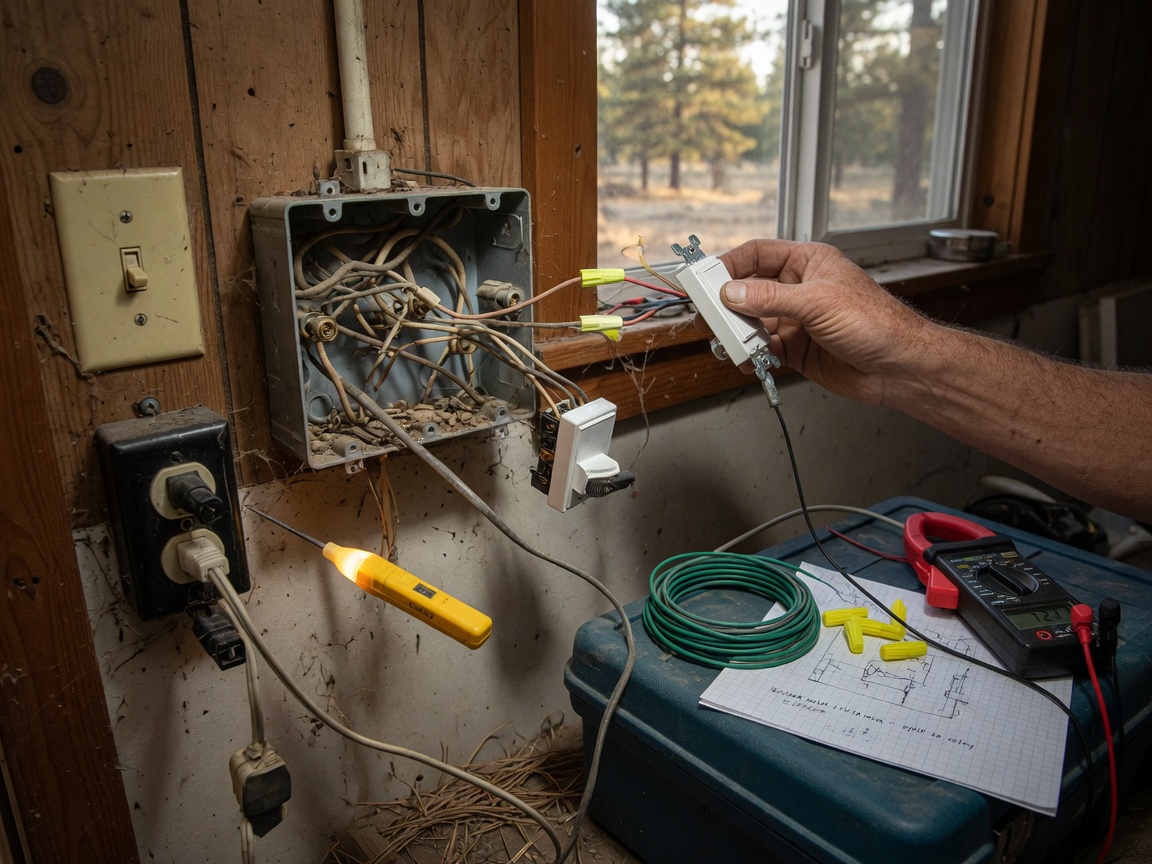
Adding smart switches without overloading older wiring in La Pine means staying under 80% of the breaker rating—12 amps on a typical 15-amp lighting circuit—by using switches that draw 0.5–1 watt at idle, confirming 14-gauge or 12-gauge copper can carry existing lights plus the extra electronics, and measuring real load before any swap. Many Deschutes County houses around Downtown La Pine already share those circuits with space heaters once winter temperatures drop, so the tiny extra draw only stays safe if you treat the whole run as one system instead of a single wall box.
Check Circuit Load Before You Touch A Switch
Start at the panel, not the wall. Identify the breaker that feeds the lights you want to convert, then add every fixture, fan, and plug on that run. A 15-amp breaker on 14-gauge NM cable, common in older La Pine stock, should not exceed 12 amps continuous. LED bulbs already cut lighting load, but a plugged-in heater on the same circuit in a high-desert winter can push the total over the limit even before a smart switch appears. Use a clamp meter on the hot conductor with everything on, then add 0.01–0.02 amps per switch for electronics. If the measured load sits at 10 amps or more, stop. Homes near the Little Deschutes River and cabins closer to La Pine State Park often have long, shared lighting runs that were never meant for extra devices. Document the number of fixtures and any outlets on the same breaker; that list tells you whether a simple swap is possible or whether you need a home rewiring conversation first. Never assume a vacant box means spare capacity.
Choose Switches That Match 14-Gauge High-Desert Runs
Most smart switches sold today list 15-amp ratings, but the rating is for the switched load, not the electronics themselves. Pick models whose standby draw is published in watts, not just “low.” In La Pine, where summers are warm and winters are cold, temperature swings inside uninsulated boxes can raise electronics heat; a switch that idles at 1 watt still adds up if you install six on one circuit. Prefer devices that work on 14-gauge copper without requiring a dedicated neutral if the house lacks one, or plan a pigtail only after you confirm box fill. Avoid stacking dimmers, fans, and smart relays on the same 15-amp lighting circuit that already carries porch lights facing the high desert wind. If the existing wire is aluminum or mixed, do not proceed with a consumer switch—those connections need professional evaluation. For whole-house plans that include more than a few rooms, look at dedicated smart home wiring rather than loading every original lighting loop. Concrete numbers beat marketing: if six switches add 6 watts idle, that is still under 0.05 amps, which is fine only when the rest of the circuit is already well below 12 amps.
Neutral Wires, Grounds, And Box Fill In Older La Pine Houses
Many houses in Downtown La Pine and nearby Sunriver-era cabins were wired with switch loops that have no neutral in the box. A smart switch that needs a neutral cannot be forced onto two-wire cable without creating a dangerous return path. Open the box, count conductors, and calculate fill: a typical single-gang box with 14-gauge wire, a switch, and a pigtail can exceed volume before you add a bulky smart device. Grounding must be intact; older runs sometimes used the armor or a bare wire that has loosened. If the box is metal and cramped, a shallow smart switch still generates heat that has nowhere to go during a warm La Pine summer afternoon. Do not stuff extra wire nuts and a Wi-Fi module into a box that already holds three cables. When neutrals are missing across several rooms, the honest path is often a new home run or a electrical panel upgrade so new circuits can be added without overloading the original lighting bus. Box fill and heat are as important as amps; both can fail the wiring even when the breaker never trips.
Winter Heaters And Why Seasonal Load Changes The Job
High-desert cold means many La Pine living rooms still use portable electric heaters on circuits that also feed lights. A 1500-watt heater is already 12.5 amps—over the safe continuous limit on a 15-amp breaker by itself. Adding smart switches on that same run is not a lighting project; it is a load-management problem. Measure in January, not July. If heaters, Christmas lights, or a window A/C share the circuit in other seasons, the smart-switch plan has to include moving those loads or adding a dedicated circuit. Readers who want to cut heater use itself can continue with reducing energy use from electric heaters in La Pine winters. Terrain and soil do not change indoor wiring, but long cable runs to outbuildings near the river can add voltage drop that makes electronics brown out and then draw more current. Treat every shared circuit as seasonal, not static. If the numbers only work in summer, they do not work.
When To Stop, Inspect, Or Rewire Instead Of Swapping
If load, gauge, neutrals, or box fill fail any check, do not install the switch. An electrical inspection of the lighting circuits is cheaper than a melted splice. Homes that need more than a handful of smart devices usually need new home runs or a panel that can accept extra breakers; see the cost guide for replacing an electrical panel in La Pine when that is the real constraint. Work from 15682 Sunrise Ridge Blvd stays available Mon–Fri 8am–6pm and Sat 9am–2pm for diagnosis, not for forcing consumer gear onto undersized 14-gauge lighting loops. The goal is a circuit that still has headroom after the electronics are in, not a circuit that only looks modern until the next cold snap. If the original wiring cannot prove 12 amps of remaining capacity with heaters off and lights on, leave the old switches in place until the feed is corrected.