2026-08-29 ·
Signs Your La Pine Home Wiring Needs Updating
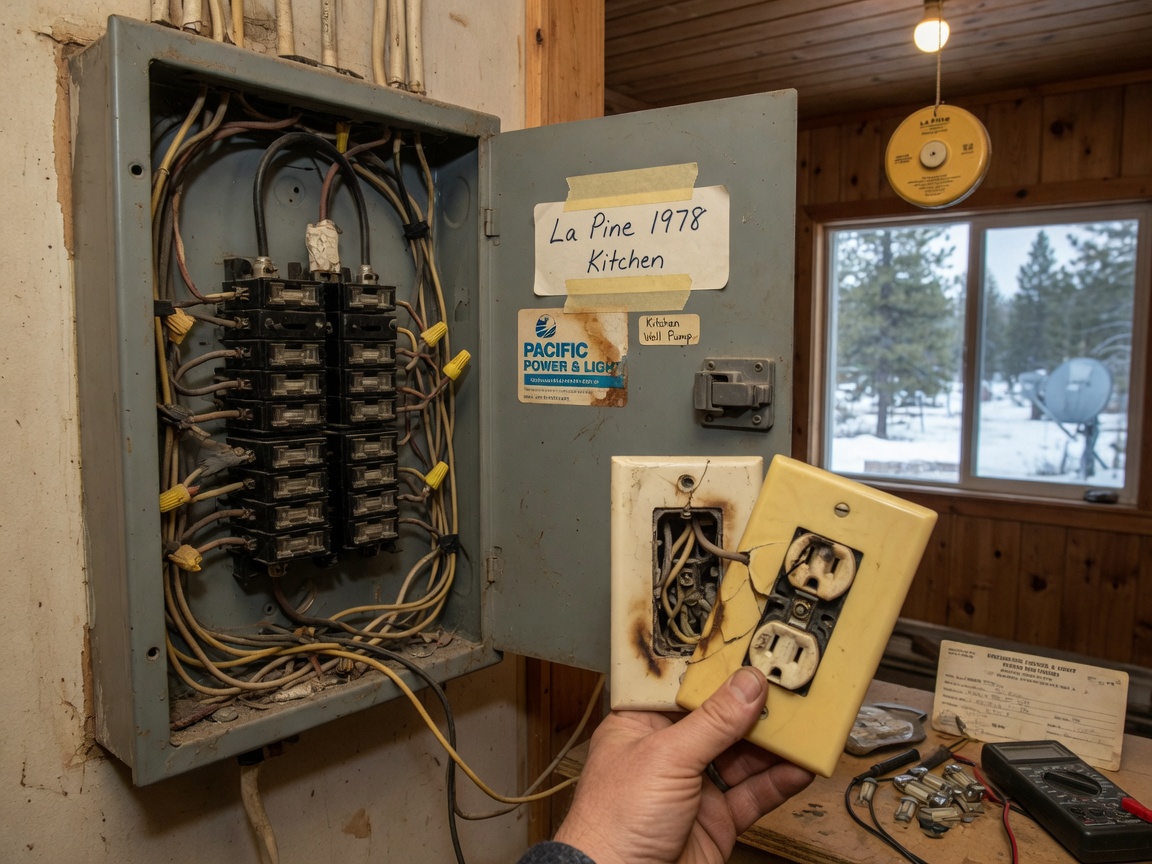
La Pine homes need wiring updates when lights flicker under load, breakers trip often, outlets run warm, two-prong receptacles remain, or you smell ozone near the panel. Those symptoms show up first in older cabins and ranch houses around Downtown La Pine and along the Little Deschutes River, where original cloth or early NM cable still feeds 1960s–1980s circuits that never saw today’s heat pumps, ranges, and chargers. High-desert winters drop well below freezing while summers stay dry and warm, so heating and cooling cycles stress every connection; if your service is still 60–100 amps or you see aluminum branch wiring, plan an inspection rather than waiting for a failure.
Flickering Lights And Voltage Drop Under Load
Lights that dim when the well pump, dryer, or space heater kicks on are the most common early warning in Deschutes County. Voltage drop of 5–8 volts on a long run through undersized 14-gauge wire is typical in homes built before 1990, especially those with additions that tapped existing circuits. In La Pine the sandy, rocky soil and freeze–thaw cycles loosen connections at boxes and panels; a loose neutral then makes every lamp pulse when a motor starts. Walk the house at dusk: if the kitchen lights sag when the microwave and fridge compressor overlap, the homerun is overloaded or the panel lugs need torque. That same sag can damage electronics and is a fire risk at splices hidden in attics that see 20–30 °F swings overnight. A licensed look at the service and a home rewiring plan often starts with mapping those circuits rather than guessing. Homes near La Pine State Park that still use original knob-and-tube or ungrounded NM show the flicker first because the insulation has dried and cracked after decades of dry air.
Breakers That Trip, Fuses That Blow, And Overloaded Panels
A breaker that trips two or three times a week is not “just old”; it is protecting a circuit that now carries more than 80 % of its rating for hours. Many La Pine panels are still 100-amp with 8–12 spaces, installed when the house had a wood stove and a few 60-watt bulbs. Today’s 240-volt heat pump, EV charger, and induction range easily push demand past 120–150 amps on cold January nights. If you have to unplug the toaster to run the vacuum, or if the main breaker feels hot after a storm, the bus bars or the feeder from the meter are undersized. Fuse boxes that still use 15-amp plug fuses for kitchen circuits are another red flag; they do not offer the same magnetic trip as modern breakers and can be bridged with pennies. After a high-desert wind event, inspect for loose lugs before you reset anything—see our notes on inspecting electrical systems after a La Pine windstorm. Upgrading the panel and adding AFCI/GFCI protection is usually cheaper than chasing repeated trips, and the cost guide for replacing an electrical panel in La Pine walks through typical ranges without guesswork.
Warm Outlets, Discolored Plates, And Aluminum Branch Wiring
Feel every receptacle after a heavy load: if the cover plate is warmer than room temperature or the plastic is brown at the slots, the connection is arcing. Aluminum branch wiring, common in some 1970s Deschutes County builds, expands and contracts more than copper; the oxide layer then raises resistance until the device overheats. Two-prong outlets without a ground path are equally risky when you add a three-prong adapter for a computer or space heater. In bathrooms and kitchens near the Little Deschutes, moisture plus missing GFCI protection turns a warm outlet into a shock hazard. Replace those devices and, if the wire is aluminum, pigtail with approved connectors rather than just swapping the receptacle. An electrical inspection will also check for backstabbed wires that have loosened after years of freeze–thaw movement in uninsulated walls. Homes in Downtown La Pine that still have original 1960s boxes often hide these problems behind paneling; opening a few boxes is cheaper than waiting for a scorch mark.
Buzzing, Burning Odors, And When To Call Before The Next Storm
A low 60 Hz hum from the panel or a faint ozone smell after the furnace cycles means a failing breaker, loose lug, or overloaded transformer tap. Do not ignore it: high-desert air is dry, so a small arc can ignite dust or insulation faster than in a humid climate. If the smell appears only on the coldest nights, the heating circuit is the culprit; if it appears after a lightning-adjacent storm, the whole-house surge path may be missing. Turn off the main if you see smoke, then call during our hours—Mon–Fri 8am–6pm, Sat 9am–2pm—from 15682 Sunrise Ridge Blvd. We serve La Pine, Sunriver, and Bend with the same straightforward diagnosis: we open the panel, torque every lug, and tell you whether a targeted repair or a full update is the safer path. Updating wiring is not about chasing the newest gadgets; it is about matching the house that sits on this high-desert soil to the loads it actually carries today.