
2026-08-29 ·
What To Do When Your Well Pump Loses Power In Winter
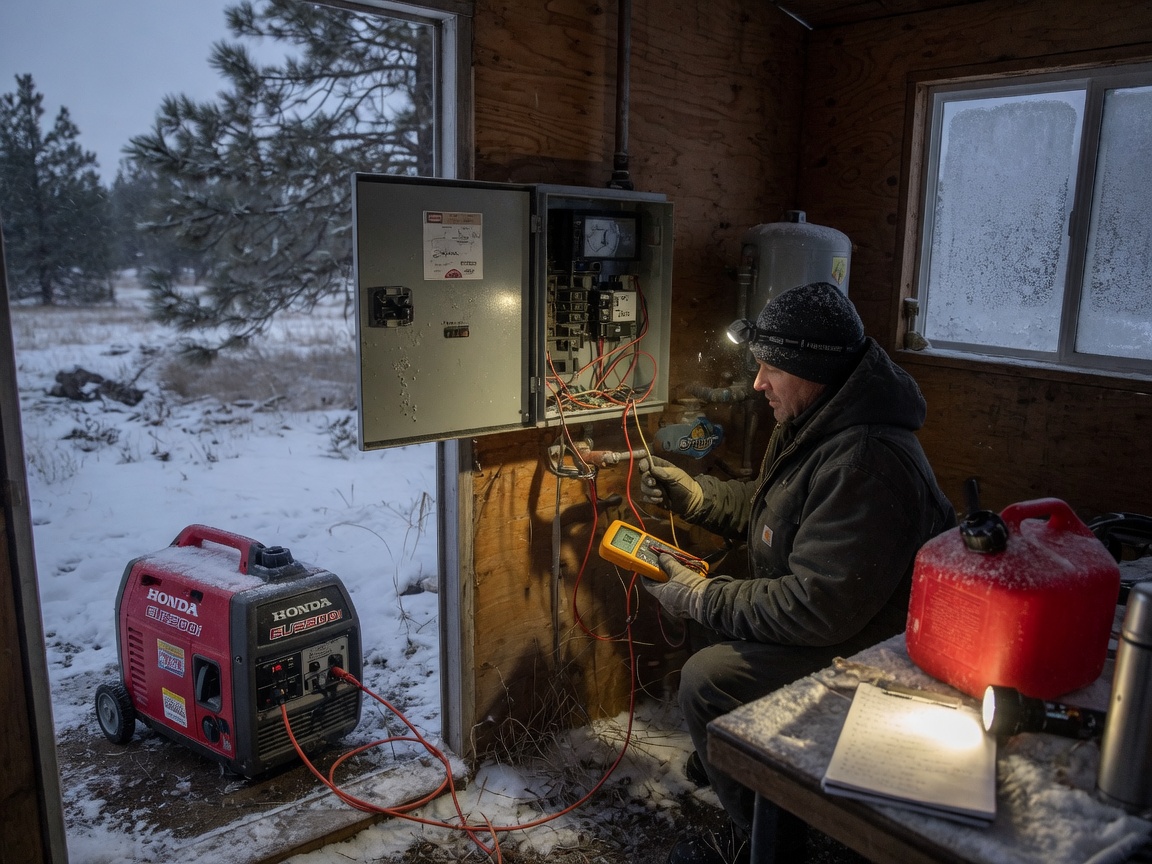
When your well pump loses power in a La Pine winter, check the dedicated well-circuit breaker and the disconnect at the well head within the first 15–30 minutes, then keep the well house and exposed lines above freezing while you restore power. High-desert nights after a storm can drop fast enough that unprotected piping starts to ice within a few hours, so the sequence is safety, freeze protection, then diagnosis—not guesswork with a generator on a wet pit. Homes near Downtown La Pine and along the Little Deschutes River often sit on older submersible setups with a single 240-volt circuit; that circuit is the first place ice, rodents, and snow load show up as a dead pump.
Check Power At The Panel And Well Head First
Start at the main panel, not the pump. Flip the well breaker fully off, then on; a half-tripped handle is common after a Deschutes County wind event. If it will not stay on, stop—do not keep resetting. Look for a fused disconnect or weatherproof switch at the well house; many cabins between La Pine State Park and Sunriver still use that extra disconnect, and ice can lock the handle. Confirm the rest of the house has power so you know it is not a whole-service outage from the utility. If lights are on but the well is dead, the problem is almost always that one 240-volt circuit, a failed control box, or a pressure-switch failure—not the motor itself. Photograph the breaker position and any scorch marks before you call anyone; that photo saves a second trip in deep snow. For repeated trips, the pattern often matches what we see in what causes frequent breaker trips in rural Oregon homes. Never stand in pooled meltwater while you reset a breaker. If the panel itself feels warm or smells like burnt insulation, treat it as emergency electrical repair and leave the well off until a licensed electrician can isolate the circuit.
Protect The Well House And Pipes From Freeze
Once you know the pump is off, the clock is on freeze damage. Open a cabinet door under a sink so residual heat from the house can slow freeze-up in interior lines, but do not run space heaters unattended in a well house—that is a fire risk on wood floors common in older La Pine stock. Wrap exposed PVC or poly at the well head with pipe insulation and a heat tape rated for wet locations if you already have one installed; do not jury-rig a shop lamp as a heat source. Drain outdoor hose bibs and any irrigation takeoffs that share the well. If you have a pressure tank in an unheated shed, crack a faucet slightly so a trickle keeps water moving until power returns—only if you still have some stored pressure. Homes closer to the river bottom can see colder air pooling at night than sites up on Sunrise Ridge, so those well houses need extra attention. Keep the well-house door shut and latched against wind-driven snow. If you must add temporary heat, use a listed device on a GFCI, not an extension cord through a cracked window. Ice forming on the pitless adapter or the drop pipe is the failure you are trying to avoid; once that happens, you are looking at a thaw-and-repair job, not a simple reset.
Diagnose Why The Pump Lost Power
After freeze risk is managed, work the electrical path. A well circuit that died during a storm often traces to a tripped circuit breaker repair from a short at a chewed cable, a failed capacitor in the control box, or a pressure switch that welded shut. Control boxes on 1/2–1.5 hp pumps sit in the well house; condensation and freeze-thaw in high desert winters crack the plastic and corrode terminals. Listen for the pressure switch click when you restore power—if you hear nothing, the switch or the 240-volt feed is open. If the breaker holds but the pump hums and will not start, the start capacitor is a common winter failure after a long idle. Do not megger or jump the pressure switch yourself unless you are qualified; a shorted motor can take the panel with it. Snow load on overhead drops from the house to the well is another La Pine-specific issue, especially after wet storms that then freeze. Underground feeders can also fail where frost heave has stressed a splice. If the rest of the property lost power too, a whole-house outage or a failed main is more likely than the pump motor. Document voltage at the disconnect if you have a meter and know how to use it safely; 240 volts present with a dead motor points to the pump or control, not the feed.
Temporary Power And When To Call For Help
A portable generator can keep a well alive, but only if it is sized for the pump’s locked-rotor amps and connected through a listed transfer method—never a suicide cord into a dryer outlet. Many La Pine wells draw 8–15 amps running and several times that on start; a 3,500-watt unit is often too small once you add a furnace blower. If you already have a backup generator hookup, use that interlock so you do not backfeed the grid. Otherwise, wait for utility restoration or a proper hookup. Call for help when the breaker will not reset, you smell burning, water is leaking at the well head, or you cannot keep the well house above freezing. We work from 15682 Sunrise Ridge Blvd with hours Mon–Fri 8am–6pm and Sat 9am–2pm; after those hours, treat a frozen well as an emergency and keep people and pets on stored water. Do not run the pump dry against a frozen line. Neighbors in Downtown La Pine sometimes share a generator for a few hours, but that still requires a correct connection. If ice dams on the roof have already stressed other circuits, that is a separate winter problem covered in preventing ice dams from damaging roof electrical lines.
Preventing The Next Winter Outage
Prevention is cheaper than a burst drop pipe. Label the well breaker clearly so anyone in the house can find it in the dark. Replace aging pressure switches and control-box capacitors before November, not after the first Arctic push. Keep the well-house roof tight and the door weatherstripped so snow does not drift onto the disconnect. A whole-house surge device will not start a frozen pump, but it will spare the control board when lightning rides in on a summer storm that later becomes a winter outage. If your panel is full or the well circuit shares a overloaded feeder, plan an upgrade in the shoulder season rather than during a freeze. Heat tape should be GFCI-protected and inspected yearly; failed tape is a common reason people think the pump died when the line actually froze. Store a few gallons of drinking water and know how to bypass an ice-blocked fixture without opening the well. After any outage, run the pump and watch the pressure gauge cycle; short cycling after a freeze often means a check valve or a cracked fitting. Treat the well circuit as a dedicated, labeled, 240-volt run with a working disconnect—that single habit prevents most winter “dead pump” calls we see across Deschutes County from La Pine to Sunriver and toward Bend.